Calligraphy, or the art of beautiful writing…
Calligraphy is the art of elegant and stylised writing. It originated in Persia towards the end of the 14th century. This art form was initially dedicated to the transcription of sacred texts and Persian poems. At that time, the reed pen, made from reed stalks, was the preferred writing tool. However, it is important to note that calligraphy already had a long history in China, where the first Chinese characters appeared around 2650 BC. Calligraphy is characterised by meticulous attention to writing, transforming a text, a word or a sentence into a work of art. There are many forms of calligraphy, ranging from Gothic and Roman scripts to more contemporary styles.
Calligraphy, a major feature of Islamic art…
In the Islamic world, calligraphy quickly established itself as an art form in its own right. It was with the emergence and rapid spread of Islam, from the mid-7th century onwards, that the art of writing flourished. Imbued with spirituality, it is used for the writing of the Quran and other sacred texts, including the ninety-nine names of God. It also embellishes poetry in Arabic, Persian or Turkish. The arrangement of the lines, the density of the strokes, the length of the extensions and the positioning of the dots all play a crucial role in the balance and visual harmony of a work.Calligraphy extends to a variety of media, whether books, albums, architectural decorations or valuable and everyday objects.
The colour and quality of the materials enhance its splendour. Based on proportions defined by the first letter of the Arabic alphabet, the alif, calligraphy offers an infinite variety of stylistic variations. Over time, calligraphers have developed and theorised various styles, some specific to Arabic, others more commonly used in Persian or Turkish. Two main categories stand out: angular scripts, or Kufic scripts, which are the oldest, and cursive scripts, developed several centuries later. The characters are embellished with ornaments such as interlacing patterns, floral motifs, leaves, or animal and plant forms.
©manomano.fr
Calligraphy: very specific tools
- Traditional tools: these include bird feathers or calamus (reeds sharpened to a point), but they are hardly used at all nowadays.
- The penholder: the most commonly used tool, which can be straight or angled depending on the desired slant. The nib is used with ink, watercolour or gouache.
- The brush: this is used to draw letters. Often used with watercolours to achieve more fluid colours, it helps create more fluid lettering.
- Chalk: chalk sharpened to a point is used for creations on blackboards.
Calligraphy, decorative elements
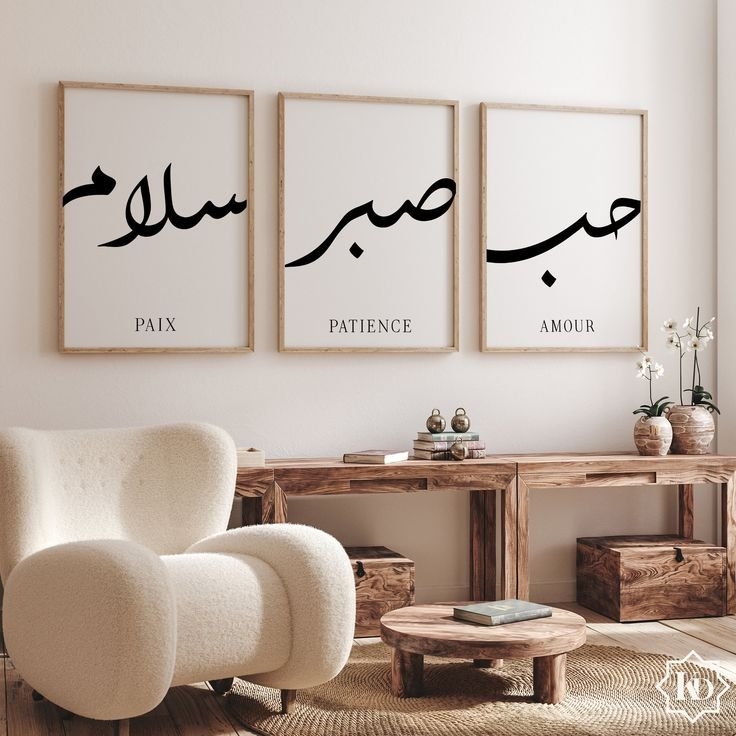
Arabic script reaches a level of extreme stylisation, sometimes transforming into a decorative motif that transcends its original meaning and becomes indecipherable. The aesthetic qualities of Arabic script make it a prime field for creative innovation. Whether in the living room, bedroom or office, these works of art bring a touch of serenity and inspiration to your daily life. 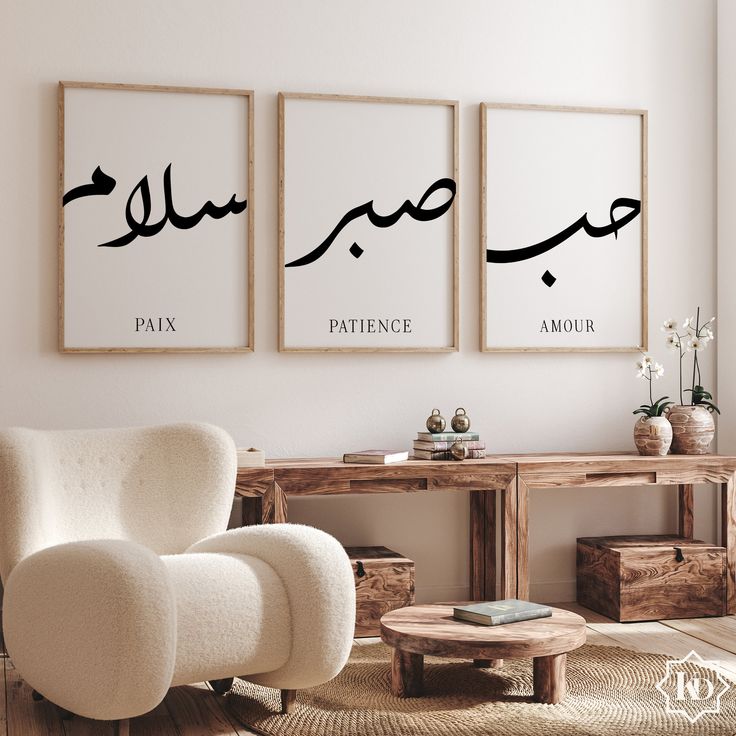
©etsy