
Like many people, I have long been concerned about the environment without necessarily always acting consistently. Then, faced with the sad reality, I realised the scale of the problem. In Mexico a few years ago, we couldn’t go swimming because the beaches were covered in sargassum. In southern Turkey, I witnessed a heart-wrenching scene where a turtle was struggling with a piece of plastic; I can assure you it had a happy ending for the turtle.
What’s more, having friends who are very passionate about environmental issues and who practise eco-friendly habits every day has really helped me grow in recent years. Africa is responsible for just 4% of global greenhouse gas emissions, yet paradoxically it is the continent where the consequences of climate change are felt most acutely. Air pollution in African cities is the second-biggest risk factor, according to the Health Effects Institute (2022)! It is therefore only natural that I became interested in the work of artists who address these issues.
Environmental and ecological themes are far more than just a trend in contemporary African art. They are a necessity and an endless source of inspiration. Many African artists are tackling societal issues, and their artistic approach aims to raise awareness of environmental, political and social challenges. They use their art to inspire positive change in the face of these issues. Ecological engagement in contemporary art takes many forms: the use of waste materials such as plastic waste, exhibitions dedicated to nature, site-specific installations, or the use of digital art.
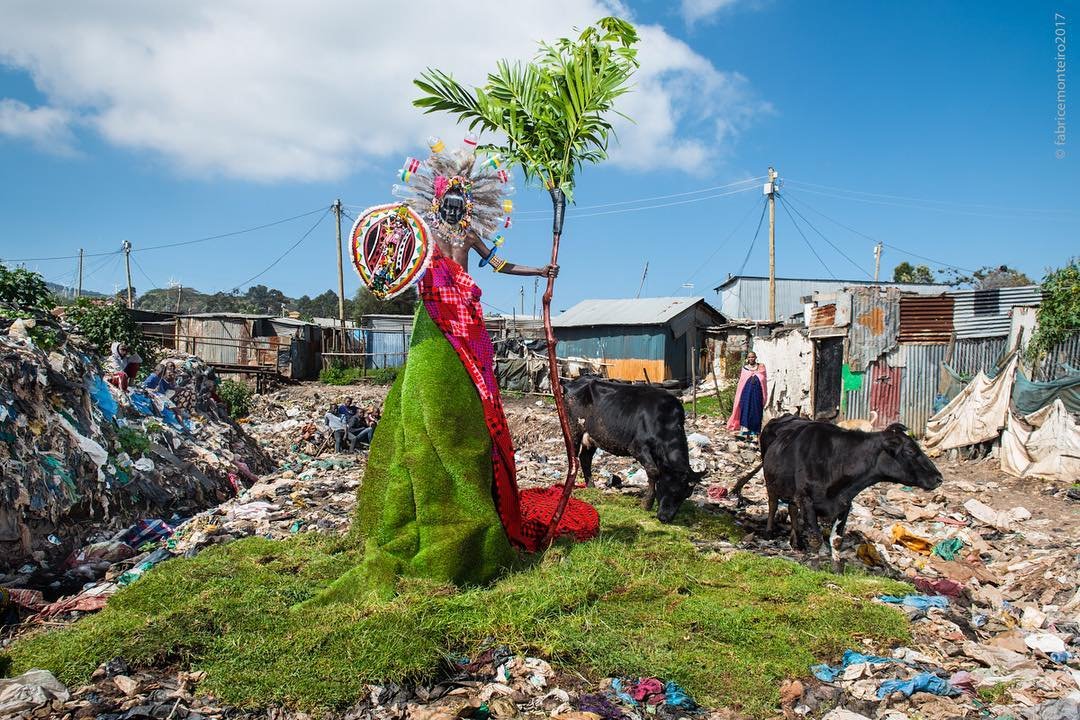
A pioneer of digital art in Senegal, the artist Piniang blends materials to explore themes of evolution and the environment. Photography also offers a powerful means of documenting the impacts of climate change and environmental degradation, whilst celebrating Africa’s natural beauty. Fabrice Monteiro’s photo series “The Prophecy” illustrates the serious environmental issues and the consequences of excessive consumption:
“The idea was born in Senegal where, observing the lack of environmental awareness, I wanted to tell a story, a tale that would combine animism and ecology to help foster an ecological consciousness in children.”
Spotlight on 4 socially conscious artists
Didier Gnepa
Didier Gnepa, known as Diafrel, is an artist committed to environmental issues. His unique works depict the world around him. Diafrel’s gentle and soothing works all bear his signature: the use of recycled materials as the backdrop for his art. In 2018, Didier Gnepa noted the high cost of art materials whilst creating the “New Africa” series. At the same time, he became aware of the astronomical amount of cardboard and other waste discarded on the streets. This is how he began using recycled materials for his creations, and repurposed materials became his tool of choice. (1) Fleuri, mixed media, 98x90 cm (2) Le défilé, mixed media, 120x105cm
Hamidou Koumaré
Hamidouis a young sculptor who lives and works in Mali. He experiments with materials he salvages, such as iron, nails, wood, plaster, cement, clay and even fabric, generally addressing topical themes and the concept of living together. Drawing much of his inspiration from female dance, Hamidou prioritises the intimate aspects of the female form. He captures, in his own way, the dancers’ dexterity, the fluidity of the movements performed, and quite simply, feminine beauty. Indeed, for this artist with a deep passion for sculpture, feminine forms are worthy of representation, even in metal, as this material bends so easily to his will. (1) Tempo series, metal assemblage, 95 cm (2) Tempo series, metal assemblage, 110 cm
Tessilim Adjayi
Tessilimis a photographer. In his work, Tessilim delves into urban memory: he observes, analyses and attempts to understand the behaviour of his fellow citizens. He also reflects on the challenges of our time. This observational work forms one of the foundations of his art. During the Covid-19 pandemic, the artist created the series "Street Vendors", in which he captured images of sellers who had left their usual trading spots (the markets) to go out and meet customers. This documentary series highlights the adaptability of these street vendors, who collect plastic, tin cans, wood, metal, clothing and even organic waste. In the series "Endemic Plastic – Humanity", Tessilim reflects on the use of plastic bags, a major source of pollution but also a health hazard to humans. (1) The street vendors of Lomé, 30x45 cm (2) Endemic Plastic and Humanity, 50x75 cm
Tidiane Ndongo
Tidiane is a visual artist known for his use of bogolan in his work. Bogolan is a traditional fabric originating in Mali, but the term also refers to a specific style of dyeing. The word bogolan comes from the Bambara language (the most widely spoken language in Mali), from the words bɔgɔ (earth) and lan (a Bambara suffix meaning ‘from’), which literally means ‘made with mud’. By incorporating these fabrics into his works, Tidiane does more than simply celebrate his cultural heritage; he also contributes to the preservation of the ecosystem by promoting less polluting production techniques and reducing dependence on synthetic materials. (1) Bogolan on cotton, 112x150 cm (2) Sabre no made, 80x123 cm