Jim Sohm
The cowrie, a small white mollusc belonging to the ‘porcelain’ family, was widely used as a means of payment in sub-Saharan Africa and Asia. Over time, it has acquired a profound cultural significance, taking on symbolic and ritualistic values. Nowadays, it has also found its place in the world of fashion. Personally, I am particularly fond of using it as a decorative element at my pop-up events.
The cowrie shell: Currency of yesteryear
Cowrie shells were used as a medium of exchange in Asia (mainly China). Their use began during the Shang Dynasty, between 1600 and 1046 BC. The Zhou Dynasty, between 800 and 300 BC, used jewellery made from cowrie shells, jade or fruit tree pits as currency. As for Africa, caravans of Arab traders were undoubtedly the first to introduce cowrie shells to West Africa, probably as early as the 8th century.
By the 15th century, these shells were already circulating as currency, particularly within the Mali Empire. The Europeans, noticing the Africans’ fondness for these small shells, helped to establish them as the primary currency in trade, particularly for the purchase of slaves and gold. Cowrie shells coexisted for a long time with several other forms of currency across West Africa (silver coins and gold dust, horseshoe-shaped copper or bronze bracelets, fabrics, beads, etc.).
However, by the 18th century, the cowrie shell had become the most widely used currency along West African trade routes. It retained its status as a means of payment, as well as a symbol of power and wealth, right up until the 20th century. Even into the early 21st century, some African countries, such as Benin and Burkina Faso, were still using cowrie shells.
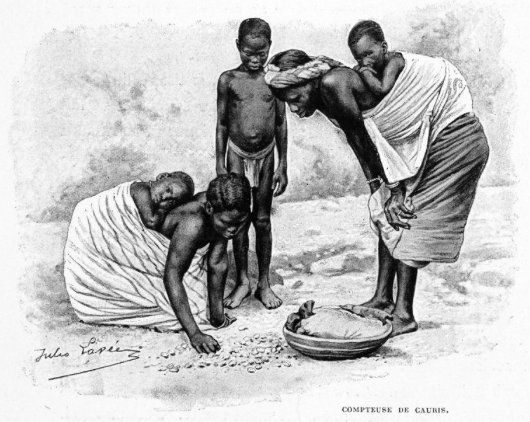 ‘Cowrie shell counter’, 1895. Source: The New York Public Library Digital Collections
The Cauri: A Treasure of Symbols and Wealth
With its voluptuous shapes, the cowrie is associated with the feminine, and, with its curved back reminiscent of a pregnant woman’s belly, it is a symbol of fertility. The slit on the underside of the shell can resemble a black pupil against the pearly surface, which is why it is often used to ward off the evil eye. This shell also has religious significance.
Animist priests use it during religious ceremonies, in their costumes or in certain objects. It is also a divination tool, as some use it to predict the future. Let us add its role as a good luck charm (talisman) which adorns the outfits of hunters and warriors, woven into sacred masks and ceremonial dance costumes. The cowrie shell can also be an element in traditional medicine, and accompany the deceased on their journeys beyond this world. 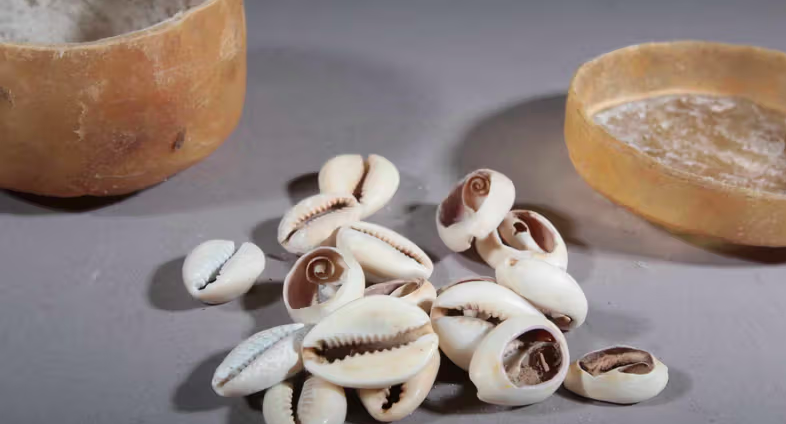
Cowrie shells in art: between tradition and creativity
Cowrie shells play an essential role in the fields of art and ornamentation. They feature prominently in ancient indigenous arts in various forms: jewellery, masks, headdresses and everyday objects.Today, they are found in a variety of artistic forms, ranging from paintings to sculptures, making their presence felt in numerous creations.
This influence also extends to decorative items, both for interiors and exteriors, including candles, vases, macramé and wicker baskets, where they are particularly prized for their bohemian charm. These small shells thus stand out for their ability to enhance the aesthetic appeal of various objects, demonstrating their decorative and artistic value. Dogon girl’s hooded mask and bustier – Mali © Bruno Mignot
The Cauri: Elegance and Influence in Fashion
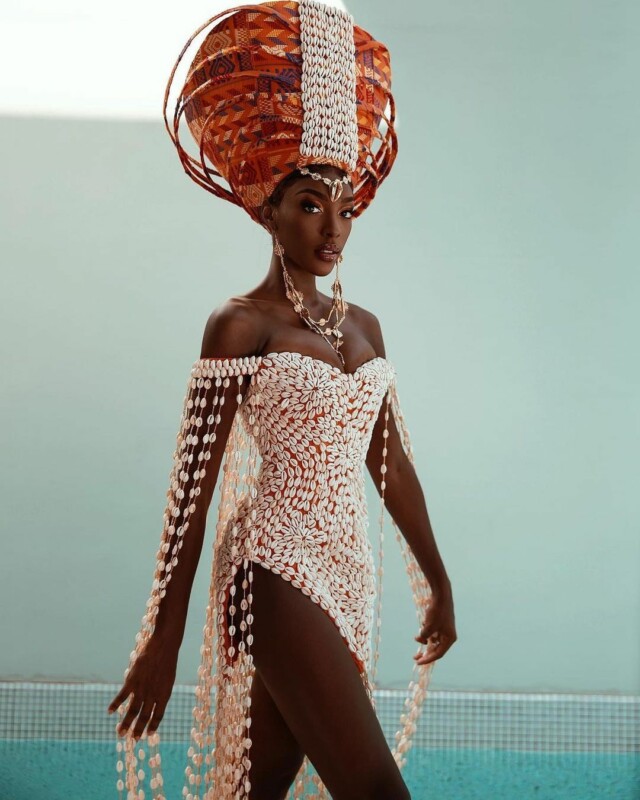
In recent years, cowrie shells have been widely used in the fashion world. Primarily used in jewellery design, they are increasingly being incorporated into headdresses, bags and sandals… La Falaise Dion is a young Ivorian designer who has chosen to make cowrie shells her signature. One of her creations was brought to the fore thanks to the singer Beyoncé, who wore it in her music video ‘Spirit’.