Born in 1970 in Bamako, Mali, Tidiane N’DONGO began his education at a Koranic school before continuing his studies at a Franco-Arab school, where he obtained his baccalaureate. Unable to secure a scholarship to study abroad, he took on a variety of temporary jobs. In 1994, he turned to learning the art of bogolan under Youssouf Sidibé Nelly in the lively Bamako-Coura district, where he quickly took charge of the workshop. Bogolan is a Malian fabric dyed using traditional methods.
There, Tidiane perfected the traditional bogolan technique, whilst adding his own personal touch with his unique style known as “Dogodogoni”, synonymous with Labyrinth and Gallery. He then passed on his expertise to the young people of Bamako-Coura and forged a meaningful friendship with his neighbour, the late Youssou Keita, a renowned artist who encouraged him in the creation of his first works of art.
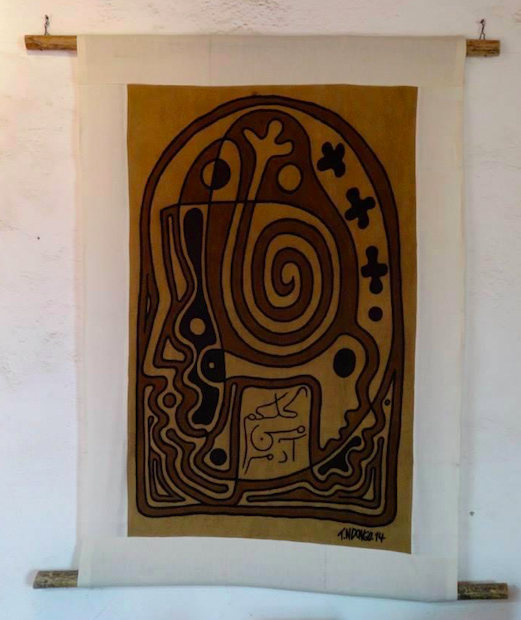
Sabre No Made
1 - Why did you choose this canvas?
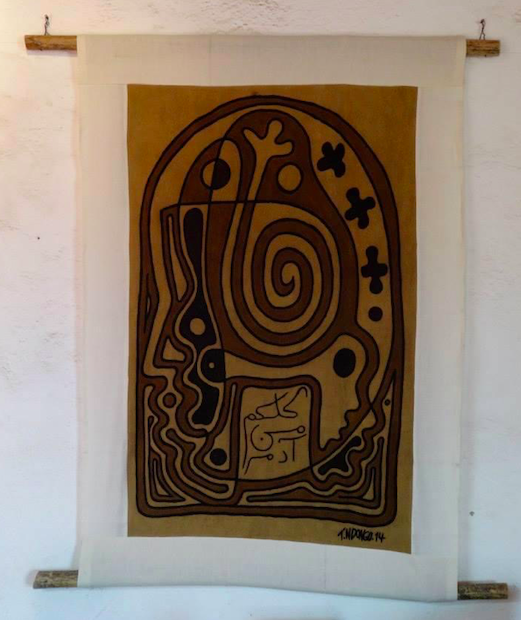
“Sabre No Made” represents almost “my whole being”: my work and my thoughts. It illustrates the contained and ongoing debate, the silence of passion, the power of words against the power of the voice, argument, literature and religion, knowledge and humour.
2 - What inspired you to create this painting?
The idea for this painting came to me through the events my country (and Africa in general) has been going through since I became “aware”. The various political crises, exacerbated in recent times by terrorism, partly fuel my work. Generally speaking, art allows me to express myself, to share my emotions, my thoughts and my view of the world.
3 - Describe your work to us
More or less recognisable faces are depicted, representing ideas that are more or less precise and statements that are more or less true. We can also recognise a slate, also known as a Quranic tablet, a symbol of study and learning to write. Writing that is nothing more than an eternal erasure, for as evolution demands, we adapt as we go along. We see a folded sabre forming a whirlwind. This is an invitation to maturity. And finally, there is a fish lifting its head out of the water with a large eye. This is an invitation to break out of routine, to be curious and, above all, to observe oneself closely. The Arabic writing on the canvas means: “you are all from Adam”, and therefore all equal. It is a nod to sacred literature. Stars are also visible.
4 - What technique did you use?
This series is created using bogolan, made from a decoction of leaves and clay applied to cotton. It involves using fermented mud to create detailed patterns on fabric, often cotton. This labour-intensive process comprises several stages: preparing the fabric, applying the mud, and repeated cycles of drying and washing to set the patterns and colours
5 - How long did it take to create the canvas? Is it still available?
This canvas was created in two weeks and yes, it is still available