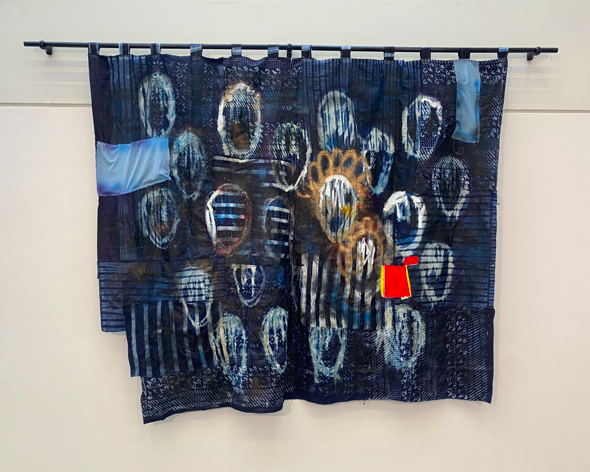
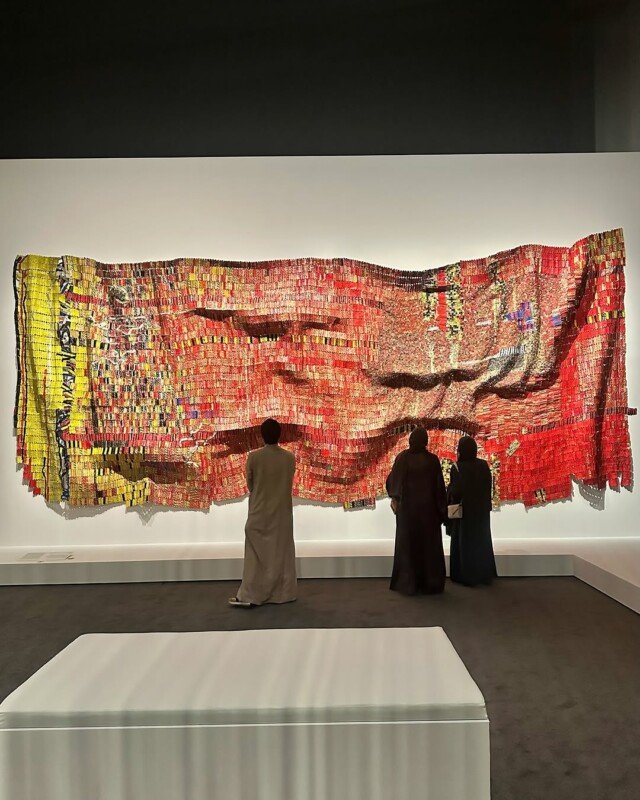
© Efie Gallery
At a time when contemporary art is restoring weaving techniques to their former glory, textile works are being revitalised by the conceptual approaches of today’s designers. Long neglected by collectors, woven and embroidered creations are increasingly prominent on the international art scene. Weaving, embroidery and knitting are gradually shaking off their negative connotations.
Over time, the regular inclusion of textile works in museum exhibitions, biennials and international art fairs has helped to restore the reputation of these practices among collectors, who had previously deemed them too traditional or too artisanal to be fully recognised within the realm of contemporary art.
In 2023, the exhibition “Sur le fil: embroidery and weaving” was presented at the IFAN/Théodore-Monod Museum in Dakar and then at the Galerie du 19M Paris in Paris. It was an invitation to a journey through eras and territories, materials and techniques, styles and symbols, celebrating material dexterity, revealing ingenious craftsmanship and bearing witness to the creative richness offered by weaving and embroidery, whether on leather, wool, silk, raffia, cotton or synthetics. Although highly valued textile works remain the preserve of a limited number of artists, compared to the market for painting or sculpture, there is no denying that the trend is shifting towards greater recognition and appreciation of this creative niche. Across the African continent, textile art has had a significant impact, capturing the essence of the cultures and aesthetics unique to each country and region.
Abdoulaye Konaté
Born in 1953 in Diré, Mali, Abdoulaye Konaté is an iconic figure in contemporary African art. A master of tapestry, sewing, painting and sculpture, he favours fabric as his material of choice for his creations. From the early 1990s, Konaté turned to textile art, initially exploring cotton before moving on to bazin to create backdrops for his installations with socio-political themes.
Today, from his studio in Bamako, he produces works that lie at the crossroads of painting, sculpture and installation. With the help of his team of assistants, he cuts and assembles strips of fabric which, when juxtaposed and layered, form masterfully crafted pieces with subtle chromatic nuances. His textile works, which have been exhibited internationally, achieved unprecedented renown and recognition on the secondary market in 2023.
© Efie Gallery
El Anatsui
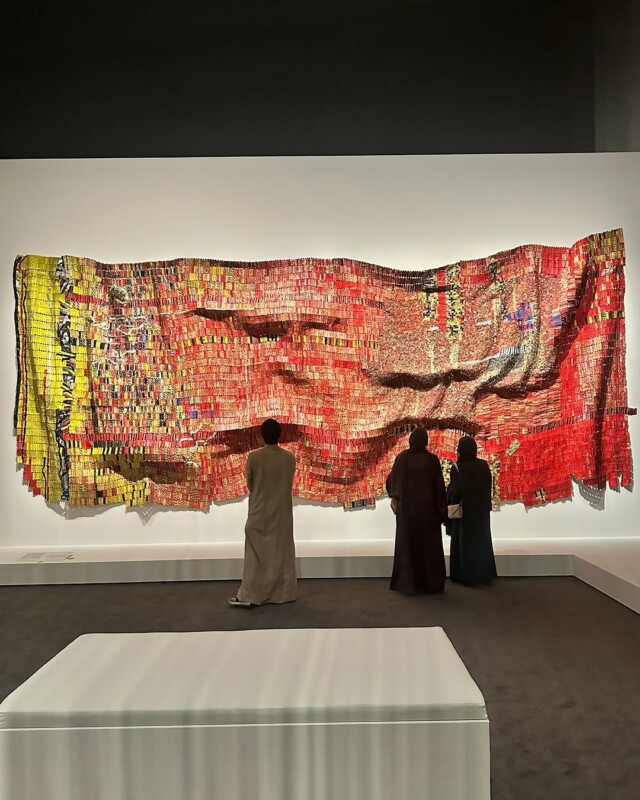
Born in 1944 in Anyako, Ghana, and currently residing in Nsukka, Nigeria, El Anatsui is an artist of global stature who was honoured with the prestigious Golden Lion at the Venice Biennale in 2015, marking an exceptional recognition for this illustrious ambassador for Africa, who had first been featured in 1990. Deeply rooted in his origins, he travels the world, captivating international attention with his works created from recycled materials.
His famous tapestries, with their golden sheen, are made from compressed bottle caps, linked together by copper wire in a complex and detailed arrangement that blends textiles, painting and sculpture. His works, often of monumental dimensions (reaching up to sixteen metres in height and fifty metres in width for the façade of the Royal Academy in London in 2013), are dazzling metal sculptures that give new life to discarded materials whilst carrying a profound metaphorical meaning, reflecting a commitment to both culture and the environment.
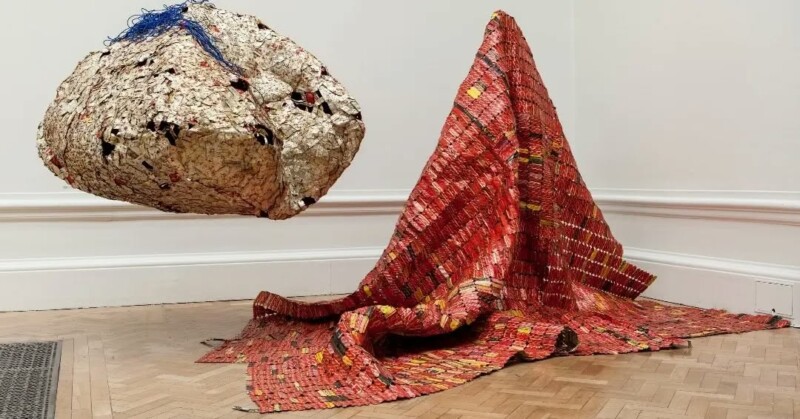
© October Gallery
Sanaa Gateja
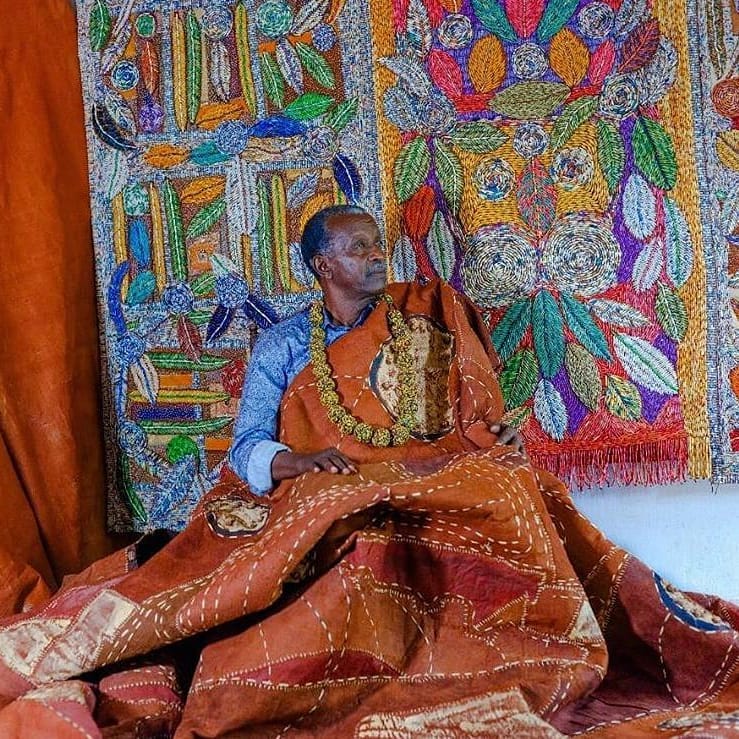
Sanaa Gateja is a multimedia artist and jewellery maker widely recognised for his signature use of recycled waste materials, particularly his innovative method of creating beads from discarded paper, which has earned him the nickname ‘King of Beads’ in Uganda. He also works with bark cloth, paper, raffia, wood and banana fibre, using these materials to construct experimental abstract pieces ranging from medium to large in scale that sit somewhere between installation, tapestry and sculpture, striking a balance between aesthetic and conceptual value.
Gateja allows the materials to express themselves within their own microcosm and ‘weaves’ them into abstract narratives commenting on the social and political realities of his home country, Uganda. Gateja studied interior design in Italy and jewellery design at Goldsmiths in London. He has exhibited extensively across Africa and internationally, including at the Karma Gallery, NYC, ARCOlisboa, the INVESTEC Cape Town Art Fair, the FNB Joburg Art Fair, Art Paris, AKAA Paris, Themes & Variations London, the Museum of Art and Design New York and the 58th Carnegie International.
Maliza Kiasuwa
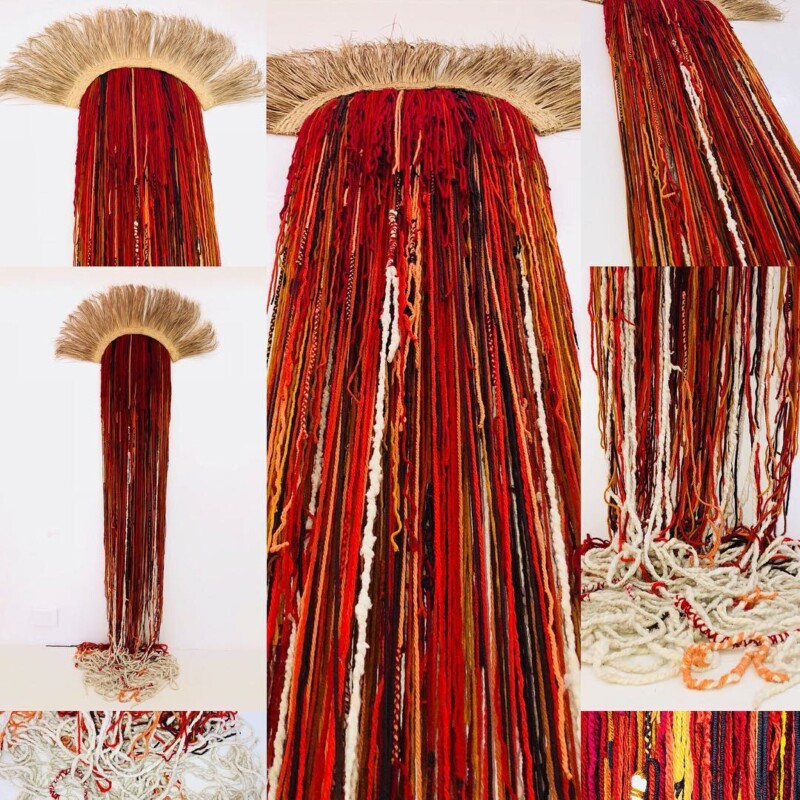
Maliza Kiasuwa was born in 1975 in Bucharest to a Romanian mother and a Congolese father. A self-taught and multi-faceted artist, she grew up between Kinshasa and Brussels, where she currently lives and works. Kiasuwa explores questions of identity and lineage through painting, sewing and collage. She revisits old engravings depicting her white, pot-bellied paternal ancestors, reimagining them with elements of traditional African art in an intimate work of cultural fusion, reminiscent of surrealism.
She also combines handmade materials from Japan with objects found around her farm. Kiasuwa embraces the prior character and vocabulary of her chosen materials, yet transforms their context. Her primary sources of inspiration are nature, the earth and the cosmos. Her interest in processes of transformation and regeneration stems from a desire to understand the mystery of the cycle of life. Philosophical and spiritual questions are at the forefront of her work. She describes herself as a weaver, as she blends materials, styles and techniques that are not meant to meet, thereby creating something unique.
© Roots Collection
Suraj Adekola
Suraj Adekola, born in 1983, is a Nigerian artist living in Manchester, UK. Suraj’s work is inspired by postcolonial narratives. He connects cultures, celebrates identity and honours heritage through painting, installation, drawing and the use of contemporary and historical materials.
In his series, “We should all be blacks”, he explores the complex relationship between being Black in Britain, drawing on postcolonial theories and historical documents. The essence of his work lies in analysing the ongoing repercussions of colonialism on the cultural identity of Black Atlantic communities. Through visual culture and historical narrative, he highlights the enduring legacies of oppression and resilience.