
Last year I wrote here about the limitations and benefits of artificial intelligence in art. I said then that the technology was inevitable, that it had to be engaged with rather than dismissed, and that engaging with it meant staying vigilant. I still believe all of that.
But I want to return to the subject, because in the space of a year the conversation has shifted.
The questions we were asking were philosophical ones. Can a machine create? Does an image made without lived experience deserve the word art? Those questions are still worth asking, and I answered them the way I would answer them today: a system can imitate a style, but it has no experience, no fear, no joy, nothing that gives a work its weight.
What has changed is that this is no longer the pressing question. The pressing question is far more ordinary, and far more difficult: who gets paid.
From the studio to the invoice
A commission that would once have gone to an illustrator, a photographer or a painter can now go to a prompt. The image arrives in an afternoon. Nobody signs it. Nobody is credited. Nobody is paid.
For an established artist, that is an irritation. For an emerging African artist with no gallery representation, no regular income and no safety net, it is a door closing. I have written before about how little margin there is behind most of the careers I support. This is the same argument arriving from a different direction.
Our images travel faster than our records
There is something specific to our scene that I think we discuss too little.
Contemporary African art has spent years building its visibility online, on social platforms, in digital archives, on sites like this one. Visibility was the goal. It was the right goal. But an image that is easy to find is also easy to absorb, and these systems are built on what is available.
Meanwhile the record underneath the image stays thin. Many artists on the continent have no catalogue, no exhibition history in an indexed database, sometimes not even high resolution documentation of their own work. Where the record is weak, imitation is cheap and proof is expensive. That is our vulnerability, and it has very little to do with technology.
What the machine cannot do
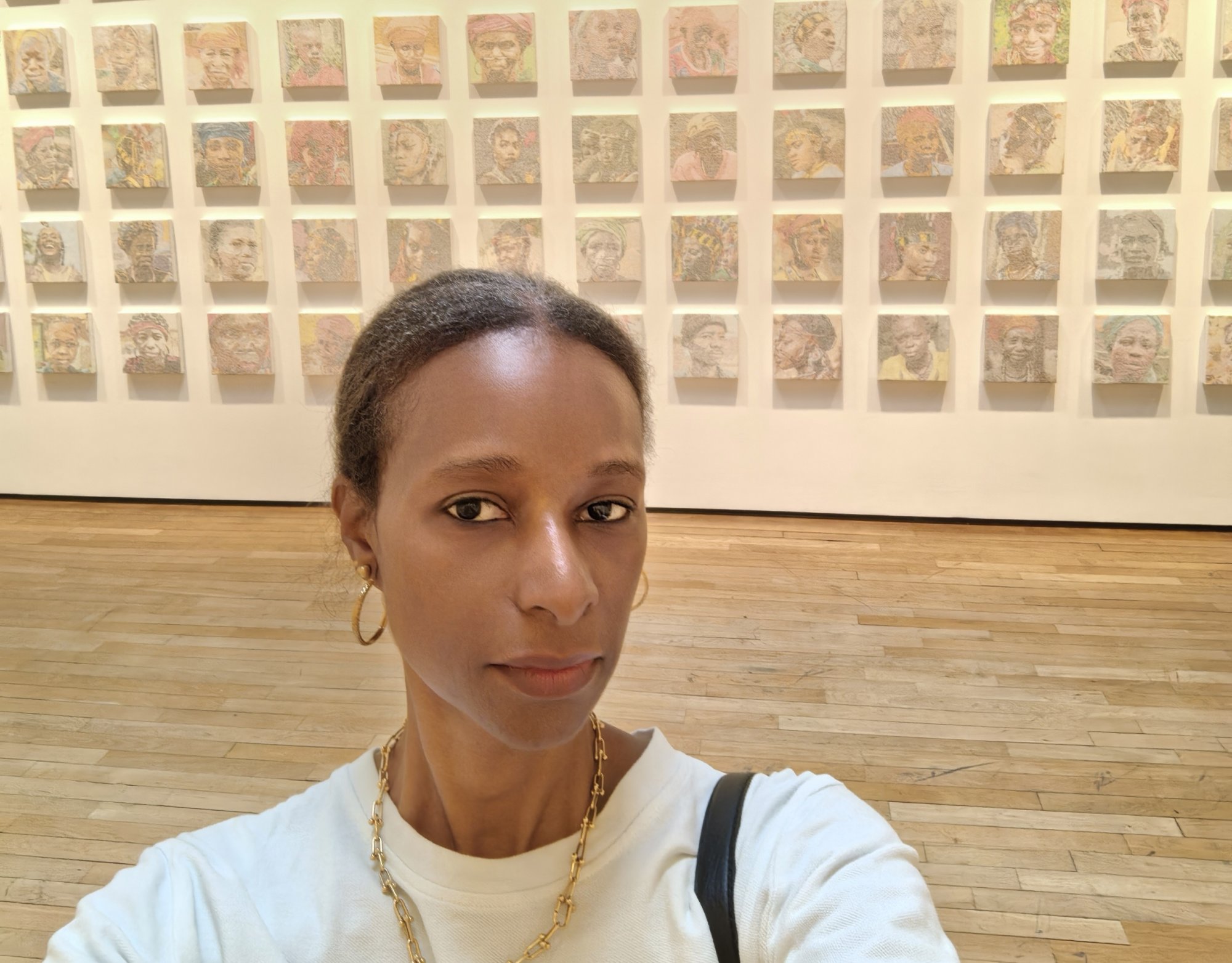
I recently spent a long time in a gallery seeing Saytu, an exhibition by Alioune Diagne; it was a wall of over a hundred small portraits. I looked at them one by one. I kept changing my mind about which one I would want at home. I left wanting to go back. No generated image has ever done that to me. Presence is not a resolution problem.
Mahamadou Khéraba Traoré builds his work around the condition of the child, as subject, as symbol, as source. Colette Diallo works across painting and handcrafted jewellery because both are needed to say what she is saying. Those are not styles that can be requested. They are positions someone arrived at.
A machine can produce an image that resembles a work. It cannot produce the reason the work exists.
What I would ask of this market
I am not asking anyone to boycott the technology. I use it, for research, for translation, for the administrative weight of running a platform in three languages. Refusing it outright is not a strategy.
Three things instead.
- Document properly. High resolution files, dated, titled, dimensions and medium recorded. An artist with a clean archive is much harder to erase.
- Write it into the agreement. When you commission an artist, be explicit about what may and may not be fed into a model.
- Buy the work. The only durable answer to a machine that makes images for nothing is a market that still pays a person for theirs.
Artificial intelligence will not decide the future of contemporary African art. We will, through what we choose to fund.