
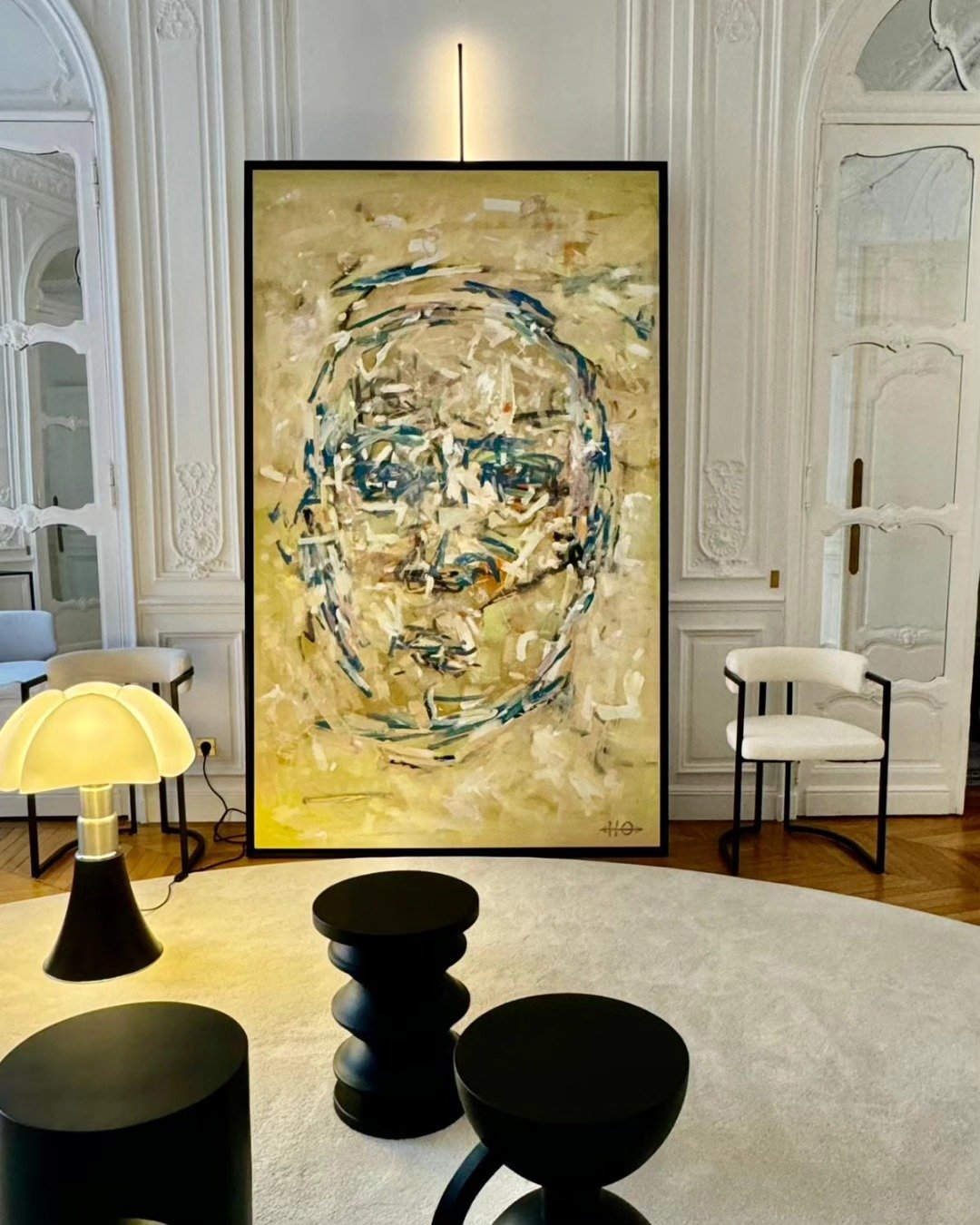
‘I’m looking for a piece of art for this wall.’
It’s a phrase I hear regularly when someone asks me to help them choose a piece of art. Often, the process begins with the space itself: the dimensions of the wall, the colours of the room, the furniture, and the atmosphere they’re aiming for. And there’s absolutely nothing wrong with that. Art is also part of our interiors, and the pleasure of living with a piece of art on a daily basis is part of the experience.
But there is a difference between buying a piece to decorate a space and starting a collection. It does not necessarily come down to the price of the work, nor to the number of works one owns. It comes down, above all, to the way in which one chooses them.
When the space guides the choice
When buying to decorate, the starting point is usually the space itself. You look for a piece of a certain size, in certain colours, with an aesthetic that complements what’s already there.
The question is often: ‘What would look good here?’
In fact, this is how many people buy their first piece of art. A flat to furnish, an office to which one wishes to give a sense of identity, a wall that has remained bare for too long. Art then comes along as a response to an aesthetic need.
And this first step can easily be the start of something else. Because sometimes, simply by looking for a piece to hang on a wall, you discover an artist. You read about their story. You look at their other works. You begin to understand their approach. Then, a few months later, you notice the work of another artist who moves you for similar reasons.
Without necessarily having set out to do so, we begin to develop an eye for art.
Collecting means starting to see things differently
For me, that’s probably where a collection begins. It’s no longer just a question of whether the artwork goes with the sofa or whether its dimensions fit the available wall space. We start to ask ourselves: Who is this artist? Why does this work speak to me? What do I want to support, preserve and pass on?
Little by little, preferences emerge. You realise that you’re drawn to photography, for example. Or to emerging artists. To portraits. To works that explore memory, identity, migration or transmission. Perhaps to a particular region, generation or technique.
A collection does not necessarily need to have a defined theme from the outset. Its coherence may emerge over time. It often reveals something about the person who builds it: their tastes, of course, but also their history, their questions and sometimes even their contradictions.
Price does not make the collector
There is still a perception that collecting is the preserve of those with substantial budgets. I don’t believe this.
You might buy a very expensive artwork simply because it fits perfectly into your home. Conversely, you might acquire a work on paper, a photograph, a small-format piece or the work of a young artist for a few hundred euros and already be embarking on a genuine collecting journey.
What changes is the intention. The collector also begins to take an interest in what accompanies the artwork: its title, date of creation, technique, provenance and certificate of authenticity. They keep this information because they gradually come to realise that the artwork has a history that extends beyond the place where it hangs today.
A collection can start with just two works
The word ‘collector’ can sometimes be intimidating. It conjures up images of grand houses, storerooms full of artworks, auctions and substantial budgets.
Yet every collection has to start somewhere.
I meet people who already own several works but who tell me: ‘I’m not really a collector.’ As if one had to reach a certain number of acquisitions before being entitled to use that word.
On the contrary, I believe a collection can begin with just two or three works, as long as you start making connections between them and thinking about what you want to build.
Nor is it necessary to know everything before you start. Your eye is trained by looking: by visiting exhibitions, talking to artists, reading, asking questions and, sometimes, getting it wrong.
What if the real test were very simple?
Decorating and collecting are therefore not two opposing worlds. One can quite naturally lead to the other. You might love a piece of art for its colours and then want to understand what it’s saying. You might be looking for something to hang on a wall and discover, almost by chance, an artist whom you’ll follow for years to come.
But there may be a very simple question to ask to find out whether you’ve moved from one to the other.
When you look at a piece of art you’re thinking of buying, ask yourself:
‘If I were to move house tomorrow and this piece no longer matched my interior at all, would I still want to take it with me?’
If the answer is yes, then perhaps you’re no longer just decorating 🙂.