
Daughter of the Rift, Osborne Macharia
An African-American aesthetic movement
Afrofuturism represents an artistic and aesthetic movement that emerged in the United States during the 1920s, coinciding with the Harlem Renaissance, a period of vibrant African-American cultural activity between the two world wars. This movement blends various genres, including magical realism, science fiction and cosmology. The movement gained momentum in the 1960s with Samuel R. Delany’s science fiction novel *Nova*, in which he recounted the exploits of a hero of Senegalese descent in the 4th millennium. From the 1970s onwards, the jazz musician Sun Ra and his Akestra orchestra promoted a cosmic aesthetic by encouraging African Americans to establish a colony in space.
The term ‘Afrofuturism’ was coined in 1994 by Mark Dery, an American academic. He defines the concept as: “the appropriation of technology and the imagery of science fiction by African Americans (…) this appropriation amounts to wresting the Empire’s cold and hostile digital tools from its grasp, in order to seize them and transform them into weapons serving the mass resistance”. Thus, the movement consists of appropriating an aesthetic and an imaginary. Afrofuturism is a multidisciplinary movement, with examples such as:
- Music: Janelle Monáe, a singer and actress who incorporates Afrofuturism into her music and performances.
- Literature: Octavia Butler, known for her novels such as Dawn (1987) and The Parable of the Sower (1993), described herself as a histo-futurist.
- Visual arts: Wangechi Mutu – a Kenyan artist whose works blend feminism, Afrofuturism and biology.
“Afrofuturists are influenced by African history, mythologies and cosmologies, technology, biology, genetics and many other alternative disciplines,” explains Ingrid Lafleur, founder of Afrotopia, a project launched in Detroit, USA. From the 1990s onwards, Afrofuturism has been used as a decolonial and emancipatory tool. It is a means of envisioning the future, creating an imaginary world and casting a dystopian and critical eye on the past. In line with this vision, in 2018 the blockbuster film Black Panther allowed us to imagine an African kingdom dominating the world through its technology, master of its own resources and, above all, one that had never been colonised. (source: Journal d'Esma no. 6). 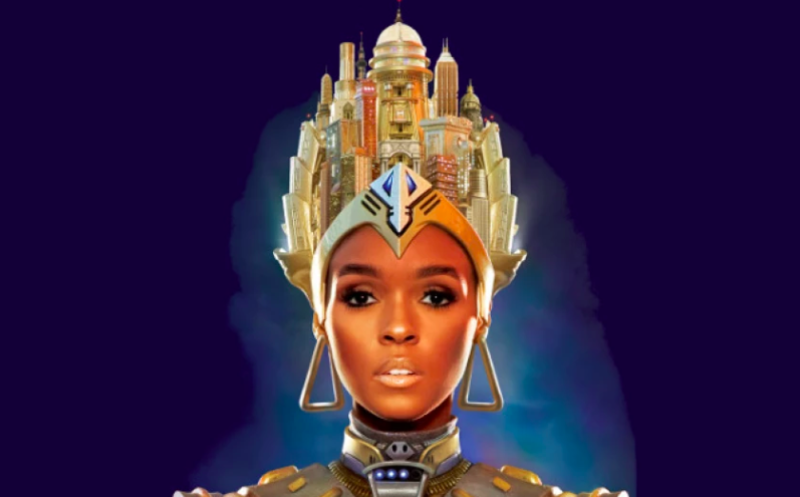
Album cover for "The Arch Android" by Janelle Monáe
Afrofuturism vs Africanfuturism
The concept of Afrofuturism has evolved over time. It has been challenged by numerous artists such as Nnedi Okarafor, an American author of Nigerian origin who coined the term Africanfuturism. According to her, “Africanfuturism is similar to ‘Afrofuturism’ in the sense that Black people on the continent and in the Black diaspora are linked by blood, spirit, history and the future. The difference is that Africanfuturism is specifically and more directly rooted in African culture, history, mythology and perspective, then branches out into the Black diaspora, and neither favours nor centres the West.’ There are therefore two branches within the futurist movement:
- The one championed by Nnedi Okarafor, who describes this movement as a sub-category of science fiction, a movement founded entirely on African cultural realities.
- The movement championed notably by Felwine Sarr in his essay *Afrotopia* and Léonora Miano in her novel *Rouge impératrice* is instead regarded as a reflection on the future of Africa.
5 Afro-futurist artists
- Kudzanai Chiurai – A Zimbabwean artist whose multimedia art explores political, social and economic themes.
- Wangechi Mutu – A Kenyan artist known for her provocative collages that address issues of gender, race and colonialism.
- Yinka Shonibare – A British-Nigerian artist who uses African wax fabrics in his works to discuss cultural identity and post-colonialism.
- Cyrus Kabiru – A Kenyan artist famous for his sculptural “C-Stunners” glasses, which reflect a futuristic vision of Africa.
- Osborne Macharia – A Kenyan photographer whose narrative images create alternative Afro-futurist worlds.
(1) Wangechi Mutu, Detail from Riding Death in My Sleep. Courtesy: Chiwoniso Kaitano (2) Cyrus Kabiru, After coup (3) Yinka Shonibare, Feeling free like a bird These artists help shape the vision of Afrofuturism through their unique creations and their commitment to representing African identity in a futuristic context.