
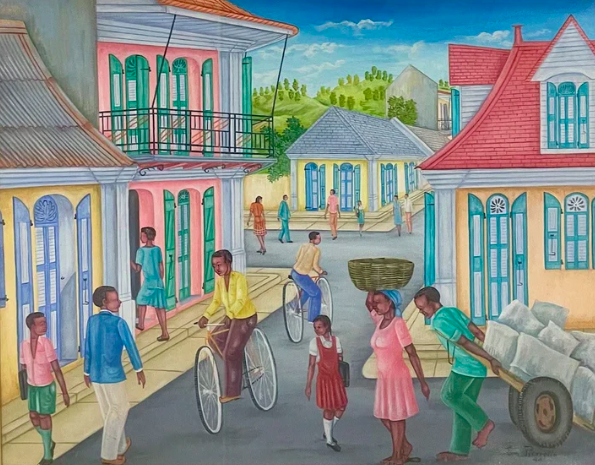
Daily Life, Emmanuel Pierrette 16"x20 – Oil on canvas
The history of art in Haiti is as captivating as it is complex. It is shaped by a blend of cultural influences, complicated political and socio-economic realities, and resilience. Here are the major periods in the country’s artistic development. The pre-colonial period, which corresponds to the time before the arrival of Europeans, is characterised by sculptures and carved objects made of wood, stone or bone. Unfortunately, only a small number of works remain.
Tainos During the colonial period, Haitian artists mainly produced works intended to highlight and celebrate the wealth of the colonists. These were portraits depicting them on their vast plantations. The Haitian Revolution (1791–1804), which broke the chains of slavery, continued the tradition of portraiture. Indeed, each of the newly freed leaders wanted their own portrait. This marked the beginning of ‘art of combat’ and a partisan aesthetic in which everyone sought to celebrate their leader.
Haitian naïve art is probably the best known internationally. It emerged in the 1940s and reached its peak with the creation of the Haitian Art Centre in 1944. The leaders, convinced of the superiority of this art form, encouraged a whole generation of artists to practise it. The first exhibition of naïve art took place in 1945 in Havana and in 1946 in Paris. One of the finest ambassadors of this art form was Hector Hyppolite, a voodoo priest who drew his inspiration from the spirits inhabiting his temple.
Spotlight on contemporary artists
Philippe Dodard
Born in 1954 in Port-au-Prince, Philippe Dodard studied at the École d’Art Poto-Mitan before entering the Académie des Beaux-Arts. Since 1971, his works have been exhibited internationally in Haiti, Suriname, Brazil, France and the United States. As an internationally renowned Haitian painter, his name and art are featured in all major books on Haitian art. His art is highly prized among collectors and art lovers worldwide. Following the devastating earthquake that struck Haiti in 2010, the artist decided to devote himself to the reconstruction of the Marché de Fer, an iconic landmark of Port-au-Prince. He also collaborated on the creation of an art therapy centre dedicated to children displaced by the earthquake.
Albott Bonhomme
Bonhomme was born in 1963 in Baie des Montagnes, a seaside village on the edge of the north-western rainforest. He worked as a fisherman and farmer with his father and attended school in Port-de-Paix. From the age of 12, he showed an irrepressible talent for painting. Having become a professional artist in 1990, he paints birds in lush settings and oases. He has exhibited all over the world.
Jean Pierre Théard
The artist was born in 1949 in the port town of Aquin. He studied architecture. During a trip to Mexico in 1969, he was impressed by the works of Diego Rivera, an artist renowned for his murals imbued with his communist convictions. In Haiti, he collaborated with well-known painters such as Pétion Savain, Villard Denis, Charles Obah and Bernard Wah, and developed a style blending Cubist and Surrealist elements. In 1973, he moved towards a style that could be described as fantastical realism. His soothing paintings seem to offer an escape from the hustle and bustle of daily life and advocate for environmental conservation. He has exhibited both in Haiti and internationally, and his works are part of numerous collections.
Clifford Jean-Félix
Clifford Jean-Félix is a Canadian painter of Haitian origin. He grew up in a family that greatly appreciated the arts. He therefore took an interest in drawing and painting at a very early age. In 1992, at the age of 20, he moved to Canada and a few months later began studying interior design. He worked as an interior designer for the next ten years. But in 2004, following a personal crisis, he devoted himself entirely to painting and was immediately and warmly welcomed by the Montreal art scene. His works are luminous and incorporate effects of relief and texture. Also notable is the recurring presence of slender figures with no distinguishing features other than a vaguely human form.