
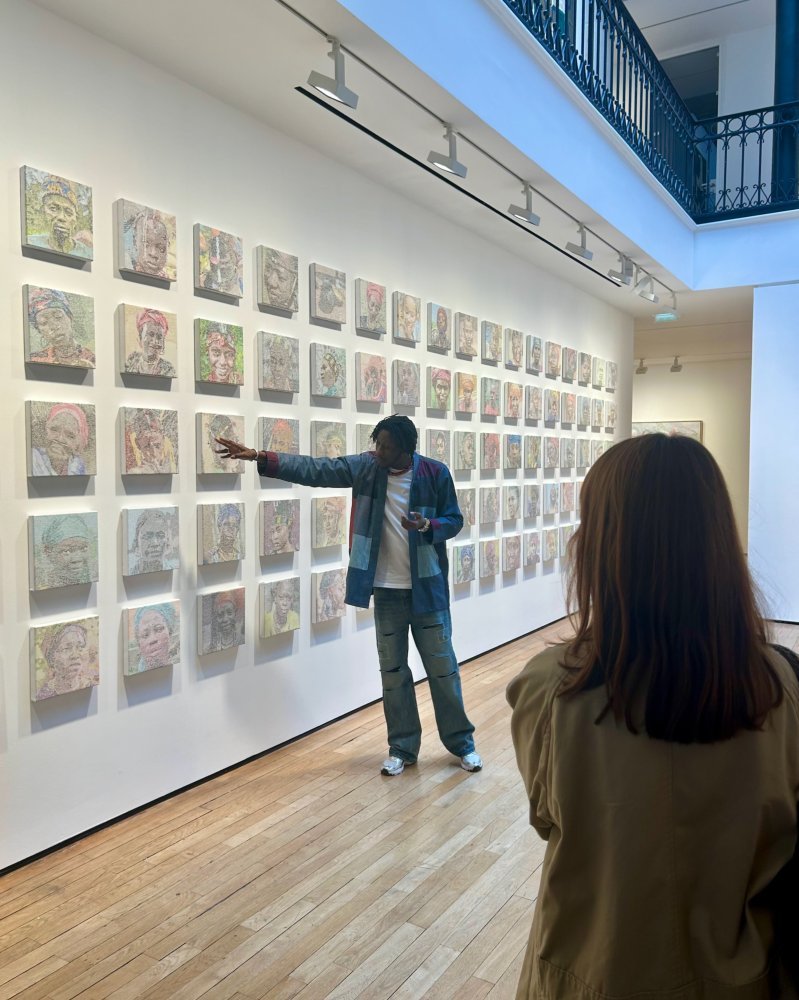
I was already familiar with Alioune Diagne’s work. I’d seen photographs of his pieces, followed his career, and was looking forward to finally seeing them in person. His visual language – made up of thousands of tiny marks which, from a distance, take the form of portraits or scenes from everyday life – is instantly recognisable. But seeing his works brought together in the Galerie Templon is a completely different experience. Some works take on a whole new dimension when viewed away from a screen. With *Saytu*, that’s exactly what happened. From the very first room, I realised that this exhibition went far beyond anything I’d imagined.
Very quickly, I found myself slowing down, looking for longer and returning to certain works.
The exhibition’s title then takes on its full meaning. In Wolof, ‘saytu’ means to seek, to observe carefully in order to find and preserve what is precious. That is exactly what one does whilst walking through this exhibition.
For several months, Alioune Diagne travelled to meet the Bassari, Bédik, Dialonké and Coniagui communities in various regions of Senegal. He does not seek to tell their story in a documentary style. Rather, he captures their memory, their energy and their presence. The dances, ceremonies, expressions and costumes become a living fabric that runs through the entire exhibition.
But what struck me most wasn’t necessarily what I’d expected. In one room, a huge wall is covered with around a hundred small portraits. I stood there for a very long time, looking at them one by one, wondering which ones I’d choose if I had to hang one in my own home :)
As is often the case, my gaze kept returning to the portraits of women. I’m not really sure why. Perhaps it was their expressions, perhaps the colours, perhaps something far more instinctive.
It’s the sort of artwork you don’t just walk past. You take the time to pick out your favourites, then change your mind a few minutes later because another face catches your eye.
I really like the colours Alioune Diagne uses. Pastel colours, but never dull. They’re soft and luminous at the same time. They don’t seek to grab your attention. Instead, they create an atmosphere. I find they make you want to get closer to understand how they’re put together.
And then there’s that very distinctive technique. Up close, all you can really see is a multitude of tiny marks. You might think it’s a made-up script. But when you take a few steps back, everything becomes clear. The faces emerge, the gestures take shape, and so do the emotions. It’s fascinating!
Whilst reading the exhibition text, I discovered that *Faces/Time*, this installation comprising a hundred portraits, brings together the faces of people the artist encountered during her journey. It’s a way of preserving a memory, but also of making us reflect on what we choose to keep today, in an age when everything is photographed, shared, and then forgotten almost immediately. I think that’s what I liked most about Saytu.
The exhibition explores traditions, transmission and heritage, yet it never gives the impression of looking back at the past with nostalgia. It shows that these stories continue to live on, that they are evolving, and that they still have much to tell us.
I left the gallery wanting to go back… and to write about this exhibition. By the time these lines are published, Saytu will already have closed its doors. I simply hope that this article will make you want to follow Alioune Diagne’s work and not miss his next exhibition.