
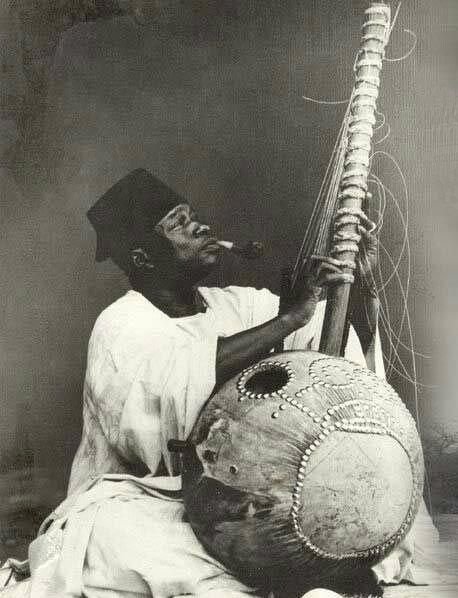
© The Metropolitan Museum of Art
The griots at the heart of the Mandinka Empire…
Guardians of oral and musical tradition, poets, travelling musicians and messengers, the griots are members of an important social caste. They originated in the Mandinka Empire. The Mali Empire, also known as the Mandinka Empire, was an African state founded in the 13th century that reached its peak in the 14th century. It encompassed much of the present-day territory of Mali, Guinea, Senegal, eastern Niger and southern Mauritania in West Africa. The griot is an emblematic and deeply respected figure in many West African societies, embodying the roles of storyteller, musician, singer and living historian.
These individuals are essential for preserving history, traditions and family lineages, passing on their knowledge through stories, songs and poetry from one generation to the next. One is a griot by birth, by blood. Being a griot is not a profession, it is a way of life! Regarded as the custodians of collective memory and cultural sages, griots occupy a central place in their communities as advisors and guardians of heritage.
A wealth of talents…
Griots are masters of:
- Genealogical knowledge: They are experts in the science of tracing origins and studying family structures;
- The art of public speaking: they know how to express themselves in public and hold the audience’s attention;
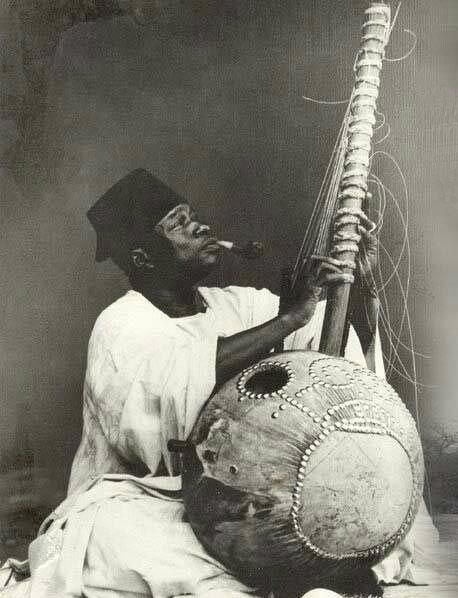
- Musical performance: they tell stories through music, notably using a kora, a type of harp.
It should be emphasised that, long before the colonial era, the literary tradition in Sub-Saharan Africa was exclusively oral and expressed in local languages. This tradition was mainly maintained and passed on by experts in the oral tradition, particularly by the griots, the true custodians of this oral heritage. Oral literature played a dynamic role within the community, on a par with other essential activities such as hunting or building.
An in-depth apprenticeship…
In village communities, the formal training of the future griot only begins after his circumcision, marking his passage into adulthood. This role is traditionally passed down from generation to generation within the same family. The apprentice griot then devotes himself to learning and memorising the history and genealogies of the clans of his village and his nation. It is common for him to also perfect his mastery of one or more musical instruments. However, mere knowledge of genealogies and musical skill are not enough to make an excellent griot.
The young aspirant first strives to forge ties with a politically influential family to benefit from its protection. Despite specialising in the history of a specific region or clan, a shrewd griot will avoid limiting himself to the history of a single family or clan, as fortune and influence can change rapidly in Africa. A previously unknown family may suddenly gain prestige and political power, which can prove perilous for the griot. A griot’s true skill is often revealed during these shifts in influence: he must demonstrate cunning and never be caught off guard, thus remaining well-informed about the various clans in his village and region.
The griot’s extensive knowledge affords him a certain degree of mobility. The most highly regarded griots are those who, thanks to their mastery of musical instruments, enjoy great freedom in narrating stories, whether sung or recited. Some griots focus exclusively on the art of oratory, whilst others combine their storytelling, whether sung or not, with musical accompaniment. Finally, there are griots who specialise solely in playing wind or percussion instruments.
Wearing many hats…
They perform various roles: they are informants, guardians of religious and secular traditions (sharing this role with the blacksmith), genealogists, biographers, but also entertainers at festivals, capable of imitating and amusing. Over time, having the freedom to practise their art, griots have distinguished themselves in various cultural events, notably by entertaining at evening gatherings. These gatherings continue to this day, including in contemporary urban settings, where storytellers share historical epics, tales and extraordinary narratives, taking advantage of the nocturnal atmosphere conducive to evoking the supernatural and spirits.
During funeral ceremonies, the griot sings the praises of the deceased and their family, perpetuating the belief that every person must know the heroic deeds of their ancestors. Thus, it is the responsibility of each tribe to pass on, orally through the griot, its exploits and history from generation to generation. The imitative griot excels at narrating epic tales, embodying famous or historical figures, and bringing his stories to life with gestures, imitations, and mime. These performances are often accompanied by masked dancers and acrobats.
The griot jesters and acrobats, for their part, frequently perform in groups, surrounded by musicians, dancers, jugglers, stilt-walkers, clowns, jugglers and magicians, distinguishing themselves through their social criticism. Present in public squares on festive days or in royal courts, they entertain, caricature, criticise with finesse and improvise. Their artistic repertoire is varied, and the lead griot plays a crucial role in raising awareness, both for the people and for the king, enjoying a unique freedom of expression in public.
As for the griots’ remuneration, it is seen as a gift rather than a payment. Offering a gift to the griot is considered an act of generosity. People give an amount at their discretion. It is also important to note that griots do not need to promote their talent for eloquence. Naturally present at ceremonies, their mere presence allows them to fulfil their role as orators. They intervene spontaneously, without invitation, arriving on the scene to play and sing.
Griots from yesterday to today...
The griot has retained his social role, although his relationship with the community has evolved. Despite the contempt of some, his importance as an artistic and social force is universally recognised. He has adapted to the urban environment, adopting modern means of communication. The telephone has replaced announcements made by drum, and the musician has taken the place of the troubadour. Thus, the griot now uses radio and television platforms to share his natural talent, bolstered by a reputation that legitimises and showcases him.
The griot acts as master of ceremonies at events of heritage significance, including military parades, as he recounts the sagas that highlight the nation’s history. He identifies as a ‘traditional communicator’. This new facet of his role presents an opportunity for governments and political figures, who can use him as a channel of communication within the community, whether during large-scale vaccination campaigns or in the context of political and social crises.Griots are also present at weddings, funerals or baptisms to sing the praises of the bride and groom’s family or the newborn.
The role of the griot is viewed in rather contradictory terms these days. On the one hand, a large section of the population welcomes the presence of a griot traditionally linked to their family for social occasions, whilst on the other, his role—deemed obsolete—and his supposed “idleness” are the subject of criticism in public discourse. Indeed, the sums distributed during ceremonies are becoming increasingly large.
Without the griots who still pass on history today, the majority of the ancient works that now form West Africa’s social and cultural heritage would have been forgotten long ago.