Could you tell us about your background and what led you to become an artist?
As for my background, it’s purely technical – specifically in electrical engineering and then computer science. This was driven by my curiosity and my love of working with objects.
As for what prompted me to become an artist, the truth is, I never actually dreamt of being one. I didn’t even know such a profession existed. I’ve always been passionate about vehicles and dreamt of becoming a car designer. In fact, cars were what I drew most often, right from nursery school. I remember that between Year 1 and Year 6, I was already selling my drawings.
Alongside my studies, I never stopped drawing. Moving from one foster home to another, drawing was a way for me to unwind and connect with myself. Those were the only moments when I felt free and when I can say I was at peace.
It was through meeting people – particularly those who shared my passion and were more experienced – that I began to hear about art and artists. But most of the artists I met were either teachers or ran a screen-printing workshop. That wasn’t the vision I had deep down of art and the artist. So I carried on drawing just to pass the time.
In 2016, I discovered the Visual Arts and Fine Arts Club at the University of Maroua, which I joined. There, I learnt a little more about art and the artist’s craft. In 2020, I began learning oil painting, particularly enamel painting. In 2021, after completing my bachelor’s degree in computer science, I decided to take the plunge and devote myself to research and my artistic practice. That’s how it all began.
How would you describe your artistic world to someone discovering your work for the first time?
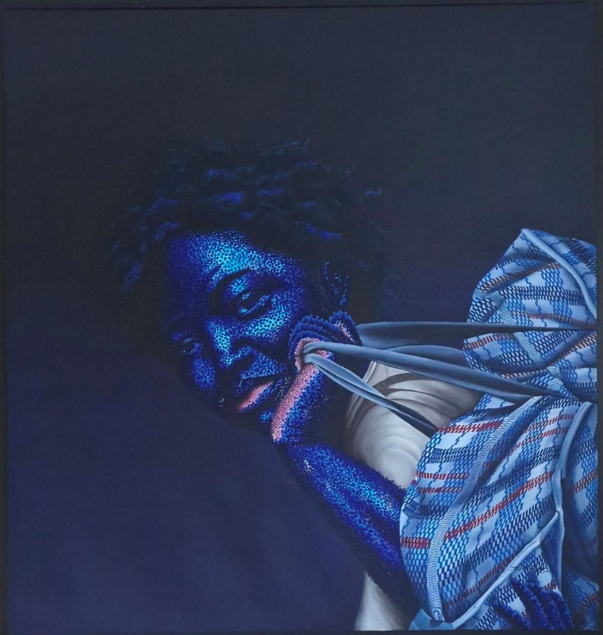
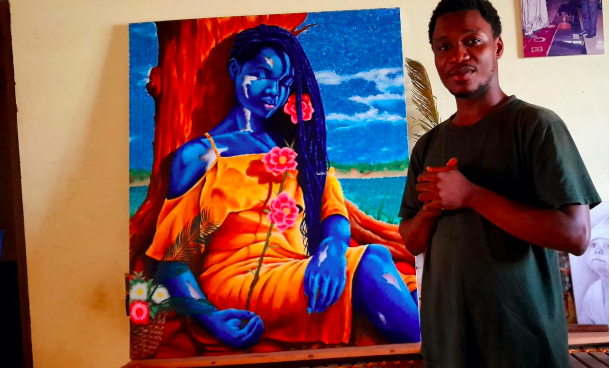
My work is created using acrylic paint. My subjects are predominantly blue and depicted in the form of granules, thus conveying the nobility and vulnerability that characterise us all as human beings, beyond our social differences and affiliations.
What are the themes or concerns that most frequently run through your work?
My work focuses mainly on themes such as identity, resilience and memory.
Where do you draw your inspiration from? Are there any personal experiences, places, stories or cultural references that particularly fuel your creative process?
My work draws heavily on my childhood, my own experiences and the various places where I have lived, but also on the experiences of those around me, whether close to me or further afield.
Having always lived in care homes, my work is also inspired by my search for identity, my roots and, above all, my desire to understand the very essence of existence.
Can you tell us about your creative process? How does a piece begin for you: with an idea, an image, a material, an emotion?
My creative process often begins with an emotion, which then transforms into an idea. Then comes the moment when I need to bring that idea to life.
As a figurative artist, I then look for an image that matches the idea, before creating the atmosphere that goes with it, based on how I feel and what I wish to convey.
Among the works you’re presenting today on Art Kelen, is there one that holds a special place for you? Why?
What do you want the audience to feel, understand or question when they encounter your work?
I hope that everyone can identify with others, see themselves reflected in them, and realise the futility of it all.
How has your practice evolved in recent years, and in what direction would you like to see it develop today?
In recent years, I’d say I’ve evolved considerably in both visual and thematic terms. In particular, I’ve enriched my practice through the use of ultramarine blue – a symbol of nobility – but also thanks to numerous exchanges with senior artists and certain gallery owners.
I have also made progress in my quest to explore the very essence of existence, as I believe many of us find ourselves pondering this question. We are always seeking to create, and we sometimes go so far as to create things that could destroy us. The case of artificial intelligence and robotics raises particular questions for us in this regard.
What does joining Art Kelen mean to you, and what would you like collectors and the public to discover about your work through the platform?
First of all, I’d like to thank Art Kelen for this opportunity and for everything it does for the arts in general.
For me, Art Kelen is a platform that gives me the opportunity to increase my visibility, to communicate more effectively about my work, and to promote the themes I champion through my artistic practice.